
AI: Revolutionary Technology…or Next Bubble?
AI: Revolutionary Technology…or the Next Bubble?
One of the questions I get most often these days is: “Are we in an AI bubble?”
It’s a fair question. Artificial intelligence dominates headlines, technology stocks have surged, and companies are spending hundreds of billions of dollars building AI infrastructure. To many investors, the parallels to the late 1990s dot-com boom seem obvious.
As with most important investment questions, the answer isn’t black and white.
The Case for an AI Bubble
Those who see bubble-like conditions point to a few legitimate concerns.
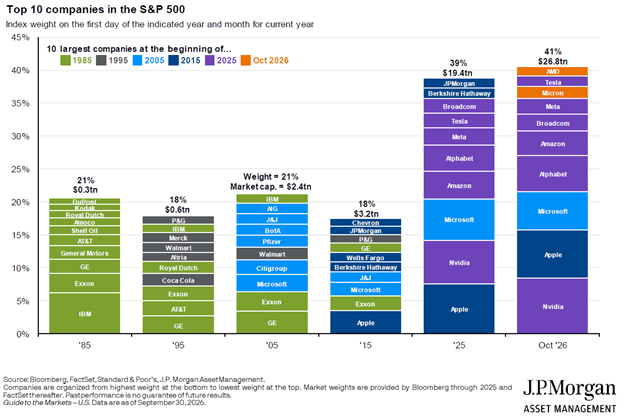
First, market leadership has become increasingly concentrated. A handful of mega-cap technology companies account for a significant share of the S&P 500’s gains, creating a market dynamic where a small group of stocks exerts an outsized influence on index performance. The chart below shows the ten largest companies now represent approximately 41% of the index’s market capitalization.
Second, companies are spending enormous sums on AI infrastructure. The major “hyperscalers” (Amazon, Microsoft, Alphabet, Meta, and Oracle) are expected to invest roughly $800 billion in AI-related capital expenditures this year alone, primarily for data centers and computing infrastructure. Skeptics question whether future profits will justify these investments.
Finally, history teaches us that transformative technologies often experience periods of excessive optimism. Railroads, radio, the internet, and renewable energy all delivered world-changing innovation, but investors who paid any price for growth often endured significant volatility along the way.
Why This Time Looks Different
While those concerns deserve consideration, today’s AI environment differs from the dot-com era in several important ways.
Most importantly, today’s leading AI companies are highly profitable businesses generating enormous cash flows. Unlike many internet companies in 1999, the firms driving the AI boom are not speculative startups with uncertain business models. They are some of the strongest and most profitable enterprises in history.
The valuation picture is also far less extreme than what investors experienced during the dot-com bubble. The S&P technology sector trades at approximately 21 times forward earnings compared to about 55 times at the peak of the dot-com era. In fact, current technology valuations are less than half of their 2000 extremes.
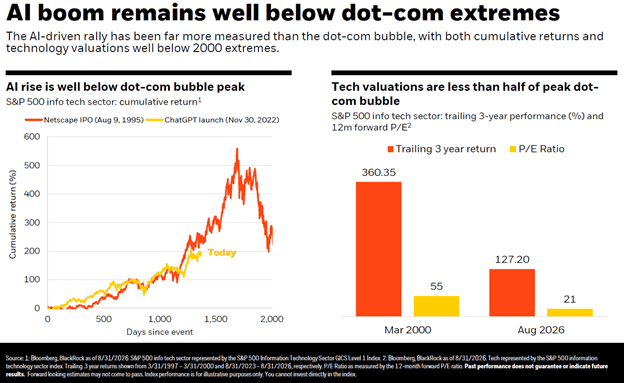
Additionally, the AI-driven advance has been much more measured than the late-1990s rally. The cumulative gains in technology stocks since the launch of ChatGPT remain well below the explosive rise witnessed after Netscape’s IPO during the internet boom.
Earnings Are Supporting Valuations
Another key distinction is that earnings growth is helping support current prices.
The S&P 500 currently trades around 19x forward earnings, above its long-term average but still significantly below the 25x multiple seen at the market peak in March 2000.
More importantly, analysts continue to project robust earnings growth. AI-related industries such as semiconductors, hyperscalers, software, and hardware are experiencing strong revenue and profit growth, helping justify higher valuation multiples.
Valuations always matter, but they’re most meaningful when considered alongside growth opportunities. Investors are willing to pay higher multiples for businesses whose earnings are growing rapidly and whose markets are expanding dramatically.
The Economic Impact Could Be Just Beginning
Perhaps the strongest argument against the bubble narrative is the potential economic impact of AI itself.
Unlike many previous technology trends, AI is already demonstrating measurable productivity benefits across industries. Businesses are increasingly using AI to automate tasks, improve decision-making, accelerate research, and increase efficiency. Adoption rates continue to rise across healthcare, finance, professional services, manufacturing, and many other sectors.
If AI ultimately proves as transformative as electricity, personal computing, or the internet, today’s investments could look less like excess and more like the early stages of a long-term economic shift.
My Perspective
Could AI-related stocks experience corrections? Absolutely.
Could some companies fail to deliver on the lofty expectations currently embedded in their stock prices? Almost certainly.
But a bubble is typically characterized by extreme valuations, weak fundamentals, speculative excess, and little connection between price and business reality. Today’s AI leaders generally do not fit that description.
While investor enthusiasm is undeniably high, the companies at the center of the AI revolution are producing real earnings, generating real cash flow, and investing heavily in technologies that appear poised to reshape the global economy.
For long-term investors, the more important question isn’t whether AI stocks will be volatile in the short run. It’s whether artificial intelligence will fundamentally transform how businesses operate over the next decade.
From where I sit, the evidence increasingly suggests that it will.
As always, our investment process remains focused on maintaining diversified portfolios, avoiding emotional decision-making, and keeping our attention on long-term fundamentals rather than short-term headlines
Q3 Market Update
Bonds Have Faced Headwinds as Rates Move Higher
While stocks have captured most of the headlines this year, it’s been a more challenging environment for many bond investors.
Bond prices and interest rates generally move in opposite directions. When interest rates rise, existing bonds with lower yields become less attractive, causing their market values to decline. The 10-year Treasury yield has climbed from roughly 4.2% at the end of 2025 to approximately 5.3% today, creating another difficult period for traditional core bond portfolios.
The Bloomberg U.S. Aggregate Bond Index, often viewed as the benchmark for high-quality bonds, has produced negative returns year-to-date as rising rates have offset the benefit of higher income.
The good news is that today’s challenges may create tomorrow’s opportunities. Bond yields are now meaningfully higher than they were for most of the past decade, with the Aggregate Bond Index yielding over 5.5%. Historically, starting bond yields have been one of the strongest predictors of future returns. Higher yields mean investors are being paid more income and may be positioned for better long-term bond returns going forward.
As always, bonds continue to play an important role in a diversified portfolio by providing income, helping reduce overall portfolio volatility, and serving as a source of liquidity during periods of equity market stress.
Where We Stand Today
As we enter the final quarter of 2026, markets have generally remained resilient despite higher interest rates, elevated oil prices, ongoing geopolitical uncertainty, and persistent inflation pressures.
Year-to-date through September 30, 2026:
- S&P 500: +12.7%
- Technology Sector: +28.4%
- Emerging Markets: +23.7%
- U.S. Aggregate Bonds: -2.9%
- Money Markets/Cash: Continuing to offer attractive yields near 4%
The U.S. economy continues to demonstrate remarkable resilience, supported by healthy consumer spending, a solid labor market, and massive business investment in artificial intelligence infrastructure. Meanwhile, corporate earnings remain strong.
While short-term volatility is always possible, the foundation for long-term investors remains encouraging: growing earnings, a healthy economy, and innovation-driven productivity gains that could support economic growth for years to come.
If you have questions about AI, the markets, or your financial plan, I’d love to hear from you.
Sislo Wealth Management is another business name for Independent Advisor Alliance, LLC. All investment advice is offered through Independent Advisor Alliance, LLC, a registered investment advisor
This material is for informational purposes only and does not constitute financial, legal, or tax advice. Investors should consult qualified professionals and consider their individual objectives and circumstances before making investment decisions. Past performance does not guarantee future results.
The performance of the noted index markets does not reflect the deduction of fees, expenses, or taxes. Investors cannot invest directly in an index. Comparisons to these markets are provided for illustrative purposes only and may not be an appropriate benchmark for all investment strategies.


